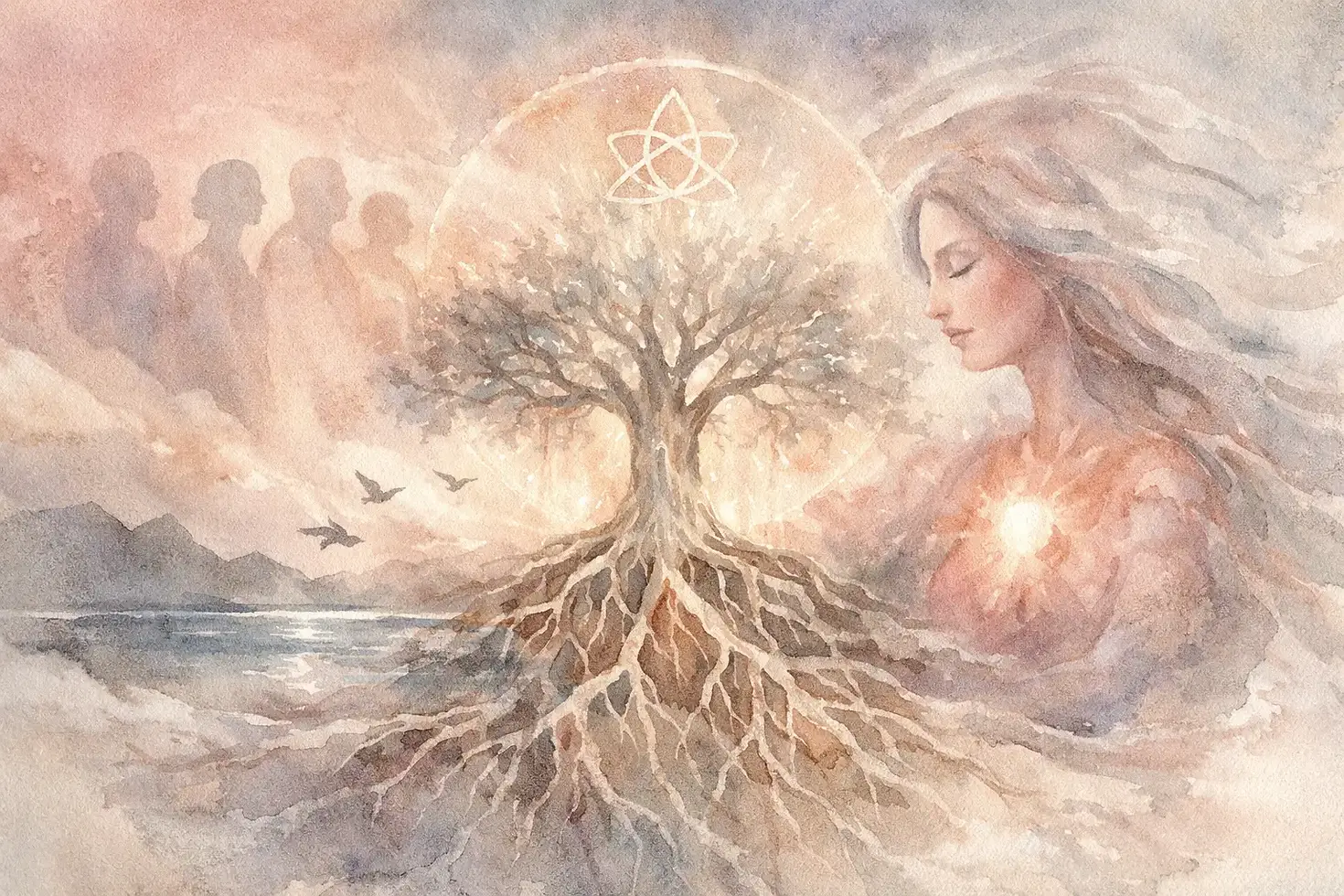
Lineage Healing Guide for Root-Level Change

There are moments when your response is larger than the moment itself. A raised voice sends your body into collapse. Receiving support feels unsafe. Success brings guilt instead of relief. A lineage healing guide begins here: not with blame toward your family, but with the willingness to see that some patterns were learned before you had language for them.
Lineage healing is not about making your ancestors the reason for every struggle. It is the practice of recognizing what has traveled through a family system emotionally, behaviorally, spiritually, and somatically, then choosing what ends with you. The work asks for honesty, capacity, and integration. Insight alone is not enough.
What lineage healing actually addresses
Every family transmits more than stories and genetics. It transmits beliefs about safety, belonging, money, visibility, gender, grief, intimacy, faith, work, and who is allowed to take up space. Some of these teachings are explicit. Others are carried through silence, nervous system responses, roles within the family, and the rules no one says aloud.
You may have inherited a deep capacity for perseverance, prayer, humor, craftsmanship, or care for community. You may also carry an unconscious agreement that rest must be earned, that women must overgive, that anger is dangerous, or that love requires self-abandonment. Both can be true. Mature lineage work does not reduce a family line to trauma. It honors the strengths while bringing unconscious survival patterns into the light.
From an energetic perspective, inherited patterns can show up as density around the heart, chronic bracing through the spine, collapse in the lower body, or a repeating sense of being pulled away from your own direction. This does not mean every physical symptom has a spiritual cause. It means the body can hold meaning, memory, and protective response that deserve careful attention.
Why insight does not always create change
Many people can name the family pattern with precision. They know their mother feared conflict. They know their grandfather survived scarcity. They understand the history. Yet their body still tightens when they need to speak, receive, or choose differently.
That is because a pattern is not only a thought. It may be a nervous system strategy. If belonging was tied to staying quiet, then visibility can register as threat even when your adult mind knows you are safe. If your caregivers were overwhelmed, your system may have learned to scan the room and manage everyone else before it notices its own needs.
This is where lineage healing becomes embodied rather than conceptual. The question shifts from, “Why do I do this?” to, “What happens in my body when I no longer do this?” The second question reveals the real threshold. It also prevents spiritual work from becoming another way to analyze yourself without changing your lived experience.
A lineage healing guide for working with patterns safely
Begin with observation, not excavation. You do not need to force yourself into painful memories or create dramatic stories about the past. Start by tracking a present-day pattern that repeats: overworking, disappearing in relationships, financial fear, difficulty receiving, compulsive caretaking, or shame around being seen.
Then locate the pattern in your system. Notice your breath, jaw, belly, chest, throat, spine, hands, and feet. Does your body speed up, go numb, become heavy, or leave the present moment? This is not a test. It is information. A pattern that lives in the body needs body-based support if it is going to change.
Next, ask what loyalty may be operating beneath the behavior. Sometimes the hidden agreement sounds like this: “If I become more successful, I will leave them behind.” “If I rest, I am like the people who failed us.” “If I tell the truth, I will lose connection.” Let the answer arise without forcing it. You are listening for an old internal contract, not trying to invent one.
Once you can name the loyalty, create a grounded replacement. This is not a vague affirmation. It is a new orientation your nervous system can practice: “I can honor where I come from without repeating what harmed us.” “My visibility does not betray my family.” “I can be connected and have boundaries.” Repeat it when your body is relatively regulated, not only in the middle of activation.
Finally, choose one action that gives the new orientation form. Make the request. Take the rest day. Keep the money in your account. Say no without overexplaining. Have the honest conversation after you have prepared your system. Integration happens when energetic recognition becomes a different decision in ordinary life.
The role of the spine, breath, and nervous system
Lineage patterns often reveal themselves through posture and regulation. The spine is not merely structural in this work. It is a central channel through which many people experience protection, expression, will, and connection to the ground. A collapsed upper body may accompany a history of silencing. A rigid back may reflect relentless responsibility. These are possibilities, not fixed interpretations.
The goal is never to diagnose a person from their posture. The goal is to restore choice. Through breath, intentional movement, rest, energy work, and spinal awareness, the system can begin to recognize that an old protective response is no longer the only available response.
This is why intense spiritual processing without nervous system care can backfire. A person may feel temporarily open after a ritual or session, then become flooded, exhausted, reactive, or disconnected. More intensity is not always more healing. Capacity matters. A skilled process helps the body orient, release in tolerable layers, and return to daily life with greater coherence.
Ancestor reverence is not ancestor idealization
Some people hesitate to approach lineage work because their family history includes harm, estrangement, addiction, violence, or deep betrayal. You are not required to excuse what happened in order to heal its impact. Respect for the lineage does not mean access for every living family member. It does not mean reconciliation is always appropriate.
You can acknowledge that people acted from their own wounds and still maintain a firm boundary. You can honor the life force that reached you through a family line while refusing the pattern of silence, control, abandonment, or abuse. Spiritual responsibility requires this distinction.
For others, the challenge is different. They may romanticize ancestry because it feels more meaningful than their current life. But lineage healing is not an escape into the past. Its measure is how you inhabit the present. Are your relationships cleaner? Is your voice more available? Can you feel grief without being consumed by it? Are you making choices from alignment rather than inherited fear?
When to seek support
Some lineage patterns can be explored through journaling, body awareness, ritual, prayer, or conversation with trusted community. Others require more containment. If exploring family history brings panic, dissociation, persistent sleep disruption, traumatic memories, or urges to harm yourself, work with a licensed mental health professional or appropriate emergency support. Spiritual practice is not a replacement for trauma-informed clinical care.
A qualified energy practitioner can also offer structure when the work feels diffuse. Look for someone who does not make sweeping claims, pressure you to cut off family, or position themselves as the sole authority over your truth. Good support strengthens discernment. It helps you become more present in your own body and more capable of making grounded choices.
At Yora Quantum Healing, lineage work is approached as part of a wider process of energetic recalibration, embodiment, and spiritual remembrance. The point is not to keep revisiting the wound. The point is to restore enough coherence that your life is no longer organized around it.
The pattern may have traveled through generations, but it does not have to remain unconscious in yours. Move slowly enough to stay with yourself. Tell the truth about what your body knows. Then let your next clear choice become evidence that a different inheritance is already taking form.


Comments